Wednesday, May 14, 2014

HAJIMEMASHITE, NIHON: KitKat Chocolatory (Tokyo)


(This is the start of a series on a recent trip to the Land of the Rising Sun. It was literally a trip ten years in the making, and a jolly good time was had by all)


Japan is known to be crazy for KitKat chocolate, and has the most variety of flavors sold anywhere in the world. According to Daily Mail, the reason for this popularity was due to how the name was pronounced - in Nihongo, it sounds like "kitto katsu", which translates to 'you will surely win'.

Nestle, the brand owner, has upped the ante, with what is billed as the the first KitKat boutique store aimed for an adult audience.  This small kiosk is located inside Seibu Department Store in Ikebukuro district. 


Somehow, i had it in my mind that this store would carry a bevy of KitKat flavors unavailable for sale elsewhere. Alas, instead of the twenty or so flavors i was expecting to gawk at, there were only three flavors on display, namely: Green Tea, Cheesecake and Chili.  Packed in small gift-sized carton boxes, with four individually-wrapped pieces inside, it is not your usual KitKat packaging form. 


Also, as we had arrived early evening, they had run out of the exclusive "Sublime Bitter" flavor, which was sold out (only 300 bars are handcrafted per day). Boo!

Verdict: Disappointing. No need to make a special trip just for this.

By contrast, you will have much better luck shopping for KitKats at Narita airport!  Take a look at the store shelves below.


Here, you can choose to your stomach's content amongst the ff. flavors: Green Tea, Chocolate, Cherry Blossom (seasonal), Strawberry Cheesecake, Rum Raisin, Wasabi (!!!), Hokkaido Red Bean paste, and probably a few more that i failed to recall. 

In short, save your money and shop at Narita airport before your flight back!


Getting There:  Take the Japan Rail (JR) Yamanote Line (i.e. the 'Green' loop), and get down at Ikebukuro station. Seibu Department Store is linked to the station exit.    


Tuesday, December 31, 2013

NO PAELLA, POR FAVOR: (Conclusion) The Genius Madman Cometh to Barcelona


When in Barcelona, it is inevitable that the name of the famous architect Gaudi comes up. And why not? Some of the most iconic attractions in this city are his creations, foremost being the  Basilica de la Sagrada Familia (which, incidentally, is not yet finished! Target completion is during 2026, the centenary of Gaudi's death).


First, a bit of info on Antoni Gaudi. As a student, he showed tons of promise, leading one of his professors to remark that he was "either a genius or a madman". His first public commission was designing lamp posts at Placa Reial, which proved to be successful. Unfortunately, he got into a dispute with the city council over the sum he was to be paid.

His private commissions (notably for rich textile industrialist Eusebi Guell) were critically acclaimed, yet invariably marked by massive cost overruns.

Gaudi was a person of contrasts. He was hard to deal with, being a loner AND a perfectionist. Yet he was also profoundly religious, and gave all his money to the church. He devoted the last years of his life totally to the construction of the Sagrada Familia. He died tragically -  struck by a tram one evening, and expiring in a hospital a few days later.


One of his worthiest creations was Parc Guell, a total flop of a real estate development (think of it as an exclusive private subdivision), but teeming with his genius.

"Parc Guell was envisioned by his friend and patron, Eusebi Guell, to be an utopian retreat far away from the hub hub of the city, construction started in 1900. However, due to World War I and the resulting crisis, work ground to a halt in 1914. At this point, only two of the planned sixty houses had been built. 

Eventually, Parc Guell was used for parties and conferences, until it was acquired by the Barcelona City Council and transformed into a public park in 1922. It was declared as a UNESCO World Heritage Site in 1984." [Source: Antoni Gaudi: His Works in Barcelona]

Check out the details on these windows:


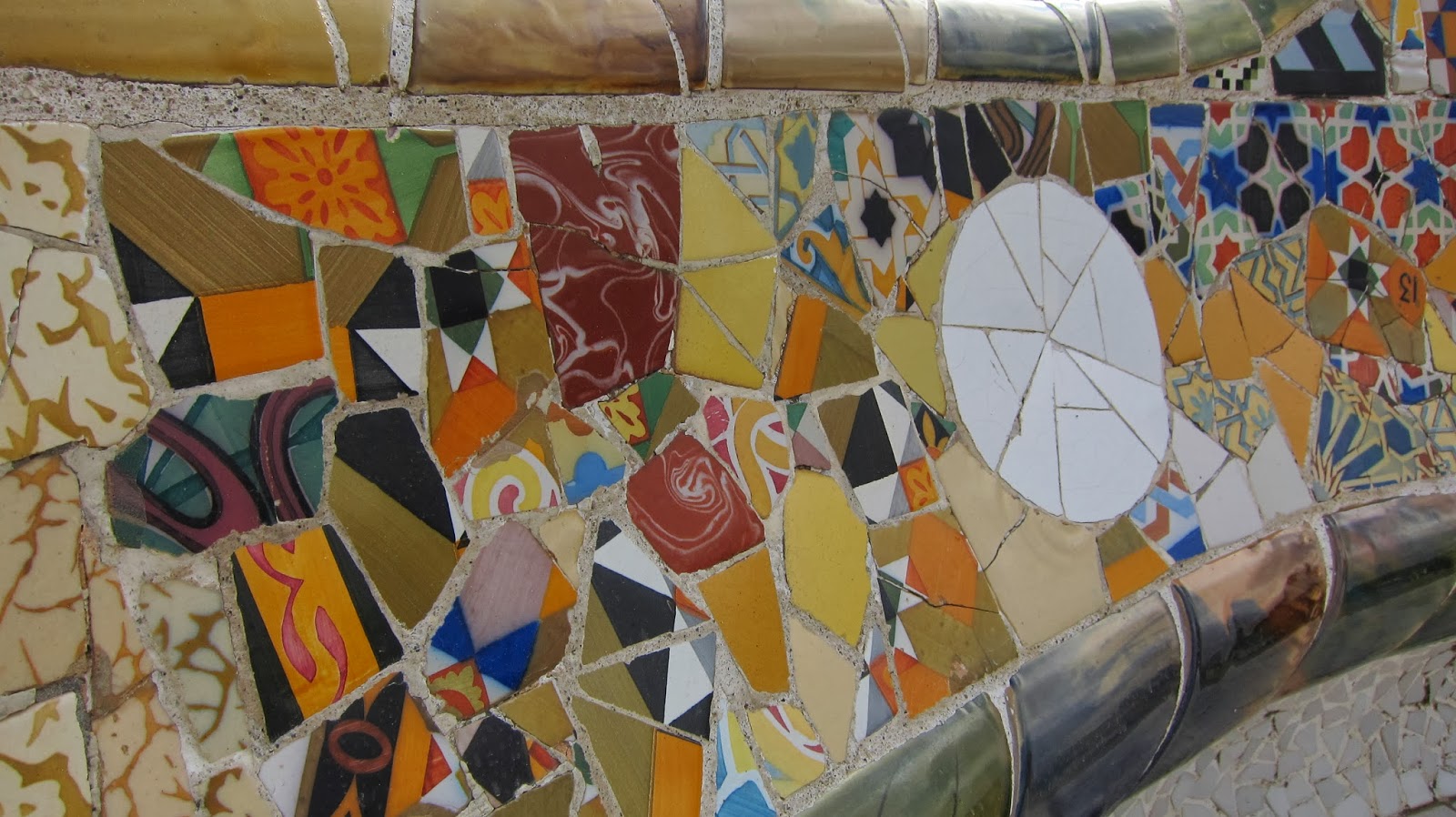
Here's a close-up of the bevy of ceramic tiles:


From the main entrance of the park, and right up the staircase is this dragon fountain, an irresistable photo-op for most tourists:


Then we have what was supposed to be the Market Hall for residents, with the ceramic artwork on the ceiling:


 How's this for a closer look of the artwork? ;-D


And the piece de resistance. These undulating, sensuous multi-colored benches, with their vibrant mosaic tiles, are truly marvelous! Under the right weather conditions, one can sit here all day, admiring the view of the city below (well, if not for the hordes of other tourists taking photos!)


 Also worth a visit to is the Gaudi House-Museum, where the architect (with his father and niece) lived from 1906 to 1926. This house was actually the 'model unit' for Parc Guell, although i don't think Gaudi did any sales-pitching to prospective buyers at that time! ;-D


 Here's this lovely female performer, playing a Coldplay tune on her violin, right outside the museum.


A visit to Barcelona is not complete without seeing at least one of Gaudi's works.  I heartily recommend the Sagrada Familia (book in advance online to avoid two-hour queues during peak season, and make sure your ticket includes a ride up to one of the towers); Parc Guell; and even taking in a FREE Gaudi walking tour for an overview of his other works - Runner Bean Tours is a very good choice.

Parc Guell is a EUR10 taxi ride away from the Las Ramblas area, taking approximately 30 minutes. Please check their official website for opening hours, ticket prices and other info.

Thursday, December 19, 2013

NO PAELLA, POR FAVOR: (Part 4) Life is like a Flamenco Show - you never know what you're gonna get.


One of the much-awaited highlights of our tour was the flamenco performance in Seville. Our guide Ieva reminded us to be on time, as the performance venue was small, and seating was on a first-come, first-served basis.

She repeatedly stressed that we were going to watch the 'traditional' flamenco. Unfortunately, yours truly did not comprehend the full significance of what she was saying then, and here lies my tale. 

All i knew about flamenco was that it was a form of Spanish music and dance - someone strumming their guitar, while a couple or a group of people danced vigorously (akin to tap dancing) with arms and hands flailing about.  Well, apparently i was wrong!

So we duly walked to the venue, Casa de la Memoria. It was indeed quite intimate, much smaller than i had expected - people in the front rows were literally a step or two away from the stage. A crew member announced that taking photographs was not allowed, except during the final ten minutes of the show; and they would give the signal accordingly. 

The performers - a male guitarist and a female singer - appeared on stage and sat down. 

'Hmmm, no dancers in sight. Strange," i thought to myself.

Things did NOT start out promisingly. The singer did not so much sing as wail. And wail she did, very very plaintively AND in quite high volume at that.  Despite my attempts to focus my attention, i couldn't help getting restless. 'Hayy, when will she ever stop?'

Then the male dancer made his appearance. Looking dapper in a dark blue shirt and black trousers, with his hair immaculately slicked back, he gave quite a whirling dervish of a performance. At the end of his solo, he was soaked and breathing hard, and his hair was tousled, oozing magnetic charm. Bravo!


Now, it was the female dancer's turn. As the male dancer sat down and joined in the clapping (palmas), the singer and guitarist continued on. 'Why don't they dance together?' i thought. With her sharp, angular facial features emphasized by her tightly bunned hair, she likewise danced with much gusto and feeling; and the audience was quite appreciative.

Finally, my wish was granted! Them dancing together! Check out the photos below from my tour mate Lisa:


And some photos from tour mate Susan:


As we exited the theater, our group was abuzz with chatter over the flamenco performance. Apparently, i wasn't the only one who wondered why they only danced together in the end. And some tour mates commented on the dark / plain attire of the performers - they had expected the costumes to be more bright and colourful.


Ieva explained that 'tradicional' flamenco tells a sad story. (So i guess this might explain the separate dancing? The lovers are star crossed and not meant for one another, maybe?) 

Further, apparently this was what she meant by 'authentic' flamenco, as opposed to the 'touristy' shows meant for . . . well, tourists who want a rousing show (like me!!! :-D)


I joked with her and my tour mates that i would come up with my own flamenco version, which would have:

- more dancing together of the couple
- more colourful costumes
- audience participation (i.e. pulling in unsuspecting members to join in in the finale)
- male dancer dipping the female in the end, and sealing it with a long, sensuous kiss (on the lips, por favor!)
- more cheerful singing!

In short, ditch 'tradicional' and go for touristy! We want a happy, storybook ending where they lived happily ever after!!! ;-D


For more info about flamenco, check out this Wikipedia entry.